
Pain Memory: Why It’s Not “All in the Past” – From Pain Science to Horse Welfare

After debunking the myth that horses feel less pain than humans (https://www.scienceforhorselovers.com/en/blog-entry/myth-or-fact-exploring-the-claim-that-horses-feel-less-pain-than-humans), we need to address another
dangerous pain myth: “The pain memory is in the past.” This is as wrong—and just as false—as the claim that horses feel less pain than humans. It is, however, less
straightforward to explain why this is the case, as it requires a deeper dive into pain physiology. If you are interested in more facts about pain in horses, you may find it useful to check out one of my earlier blogs, “Pain – Let’s talk about it”
(https://www.scienceforhorselovers.com/en/blog-entry/pain-let-s-talk-about-it ).
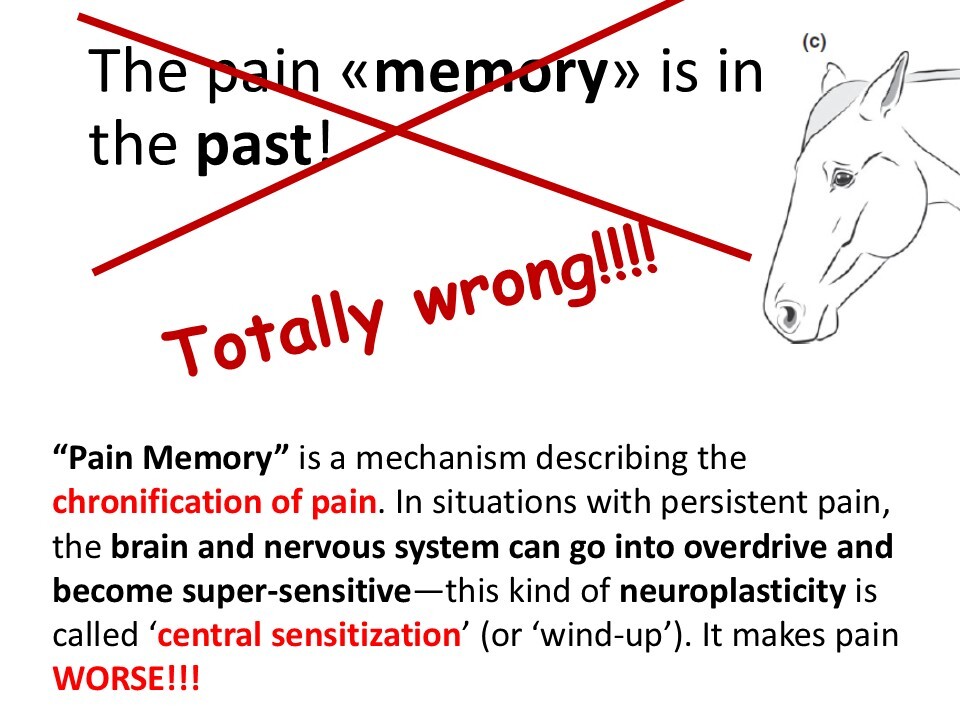
It is always good to begin with a clear definition: “Pain Memory” is a mechanism that describes the chronification of pain. The term refers to situations in which the brain and nervous system go into overdrive and become hypersensitive in response to persistent pain, stimuli that would normally cause pain, but also to non-painful stimuli. This neuroplastic (= adaptability of the nervous system) response is also called “central sensitization” or “wind-up”—and it makes pain WORSE!!! (please find a good explanation of Wind-up here: https://en.wikipedia.org/wiki/Pain_wind-up ).
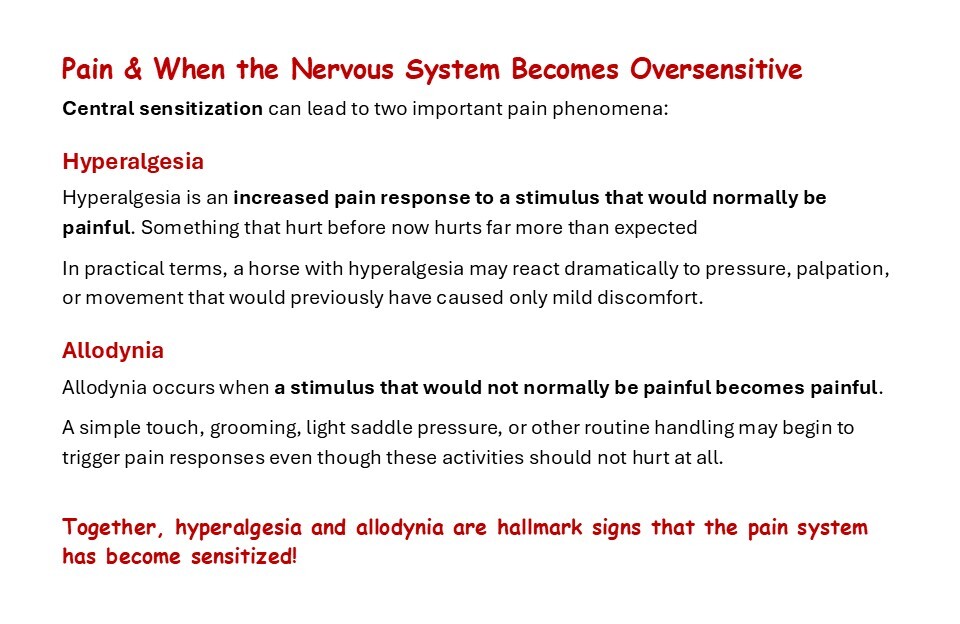
To understand what wind-up practically does to an individual, we first need to define two “technical” terms used in pain physiology: hyperalgesia and allodynia. They are not as difficult as they may sound. Hyperalgesia is when something that would usually hurt only a little suddenly hurts a lot. In this state, reasonably painful stimuli can become unbearable. Allodynia describes a state in which stimuli that should not hurt at all—such as a light touch or grooming—suddenly become painful. Both are signs that the problem is not only located in the peripheral tissues (muscles, skin, or deeper layers of the skin), but also in how the nervous system processes signals and input from these tissues. (Wikipedia provides a good explanation of both phenomena: https://en.wikipedia.org/wiki/Hyperalgesia; https://en.wikipedia.org/wiki/Allodynia ).
Figure 1: Some important definitions.
The first researchers to describe these phenomena were Raja, Campbell & Meyer
(1984). Let’s take a closer look at their classic experiment, which produced hyperalgesia and allodynia in humans and was actually quite simple and straightforward. So simple, in fact, that I managed to conduct a heroic replication—and personal reenactment— myself—although not entirely voluntarily.
In their experimental setup, Raja, Campbell & Meyer (1984) inflicted small, well-defined burn injuries on the hands of healthy volunteers and measured their sensitivity to various stimuli before and after the burns were applied. They investigated not only the injured areas themselves, but also nearby areas that showed no visible signs of injury— for example, areas outside the red flare surrounding the experimentally burned skin.
Figure 2: My personal reenactment of the classic experiment by Raja, Campbell & Meyer (1984). The red flare with burn blisters shows the area where I spilled hot coffee. Spot A is located within the red flare; spot B is outside it, where the skin appears uninjured. At both sites—A and B—I experienced increased pain in response to a stimulus that would normally provoke pain (hyperalgesia), as well as pain in response to stimuli that would normally not be painful (allodynia).
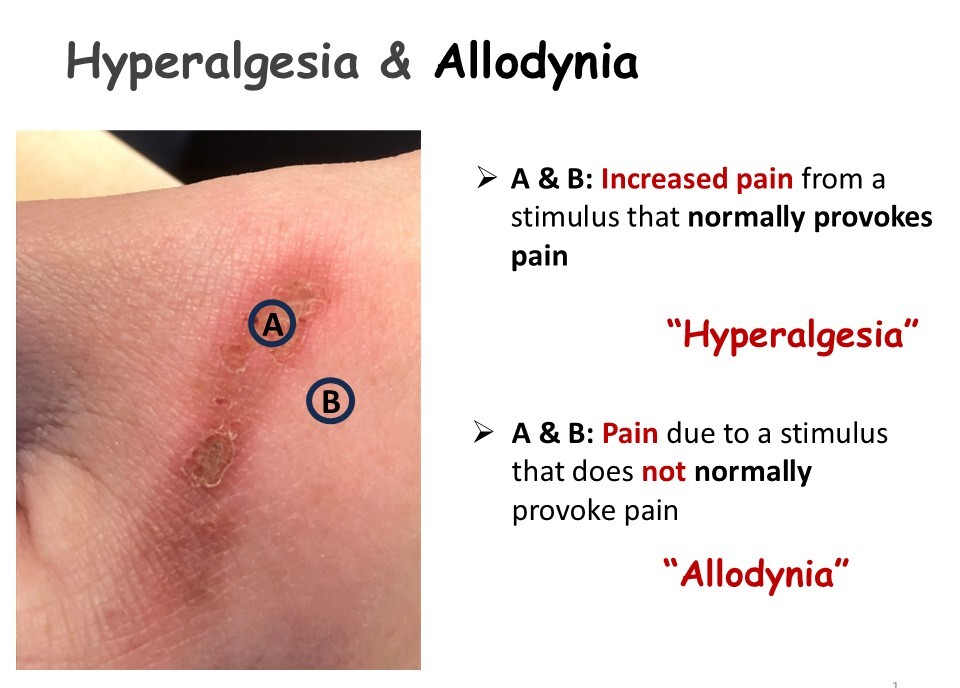
Figure 2 shows my hand after a burn caused by the “mishandling” of a cup of hot coffee. Raja, Campbell & Meyer (1984) investigated two areas in their original experiment, location A, within the burned area (the reddish flare) and location B, outside the burn. Like in the original experiment, everything felt more intense and quite painful—even light touch and cold water at spot A! Even more astounding to me—despite knowing very well, at least theoretically , that this would happen—was that this hypersensitivity to everything extended far beyond the red flare and the directly burned area, reaching spot B, just as in the original experiment. Moreover, for several days, I would have insisted that almost the whole back of my hand was painful and dysfunctional—far beyond the two defined measurement points!
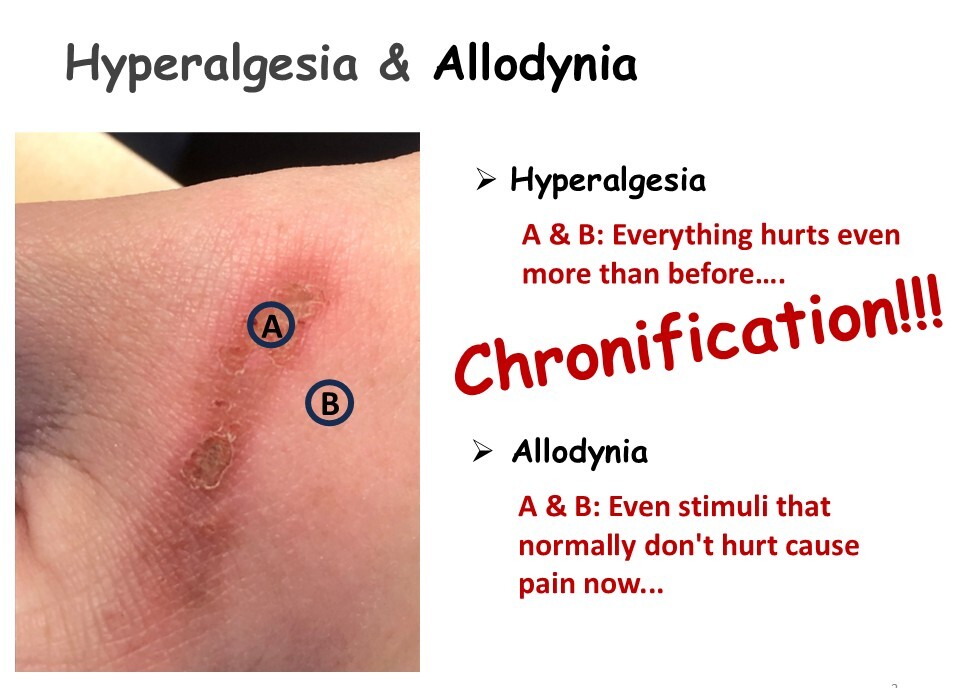
In the language of pain physiology, I experienced hyperalgesia and allodynia not only in the area of obvious injury, but also in seemingly unaffected, “healthy” parts of my hand, where the skin looked perfectly intact. In other words, I experienced two of the most important mechanisms involved in the chronification of pain: hyperalgesia and allodynia (Figure 3).
Figure 3: Hyperalgesia and allodynia in response to tissue damage—both within and beyond the damaged tissue area—are among the most important mechanisms involved in the chronification of pain.
What are the lessons learned from these results?
Most importantly: the pain at spot B—and beyond—was real, even though there was no visible injury at that location. The experience that almost my whole hand hurt, even in response to things that would never normally hurt, was real too.
In other words, you do not have to see an injury in order to experience pain.
Moreover, in more severe cases than this small “experimental” burn, the visible signs of an injury—whether in the skin, muscle, or bone, where we often cannot really see an injury—do not reliably predict the amount of pain experienced.
Well, my hand healed after a few days, and both hyperalgesia and allodynia
disappeared. But imagine if the injury had persisted—like, for example, in back pain caused by a disc prolapse. Or think about our four-legged friends: horses in a situation where an ill-fitting saddle is used over years, or perhaps even worse, in cases of e.g. an undiagnosed kissing spine syndrome.
These findings also make it clear why it is so important to address pain issues early. Treating pain appropriately when it first occurs may be one of the best ways to reduce hyperalgesia and allodynia—and, consequently, the risk of pain becoming more severe and chronic. Our knowledge and understanding of the mechanisms involved in pain chronification— and, even better, how to avoid it—has increased dramatically over the last decades, which is a real blessing. For example, during surgical procedures, whether in human or veterinary medicine, a nerve block targeting the relevant nerves that carry information to the brain is usually applied in addition to the anaesthetic that makes us unconscious.
In this way, pain-related input—called nociception at this stage—is blocked as well.
Implementing these techniques has significantly reduced postoperative pain and
substantially improved recovery times. Now you may think that this is really interesting, but perhaps a bit theoretical for our practical lives as equestrians and horse lovers. I promise you, it is not—as I know very well from my own experience. Yes, me—and I really should have known better, given my scientific background as a pain researcher. But it took me some time to make the connection: what may look like uncontrollable or “bad” behaviour might actually be the only language our four-legged companions have, to tell us that something is wrong— that they are in pain…
This distinction matters because it changes how we respond: what looks like
stubbornness or “bad behaviour” may be an animal genuinely experiencing allodynia and hyperalgesia—and therefore pain, possibly even severe pain. The fact that horses cannot vocalise their pain in the same way as, for example, dogs can make the situation even more difficult. For more on this, check out my blog “Let’s talk about pain” ( https://www.scienceforhorselovers.com/en/blog-entry/pain-let-s-talk-about-it ). Pain, in humans and horses alike, is not simply a “memory” that can be tidied away once an injury appears healed. When a horse continues to react to touch, saddling, or routine handling after tissue repair—or even after a huge investment in a new saddle—it is tempting to say that our four-legged friend simply “remembers” the pain.
However, this phrasing misses what modern pain science tells us: repeated or
prolonged painful input and experiences can rewire the nervous system, making it hypersensitive. This sensitised system can then produce real pain even when the original problem has been resolved or the tissue damage has improved. This rewiring— known as central sensitisation, or “wind-up”—means that, as you, dear reader, now know very well, the spinal cord and brain begin to detect and amplify signals more easily. Ordinary, non-painful sensations that would previously have passed unnoticed can become distressing pain experiences.
Figure 4: Pain myth number two debunked: “Pain memory” is a real-time process that makes pain worse.
A practical example: The ill-fitting saddle
There are many situations in the world of horses in our care that can trigger wind-up. Ongoing tissue injury such as e.g. poorly fitting tack, repeated low-level pain related stimulation from months of pressure, inflammatory conditions that persist, and damage to peripheral nerves can all long outlast their initial cause by keeping pain pathways activated. Psychological and environmental factors—stress, fear, and maybe even unpredictable handling—also influence the brain’s assessment of threat and can make pain networks more excitable. Importantly, none of this means the pain is imagined; rather, emotional and biological systems interact to shape the lived experience of pain!
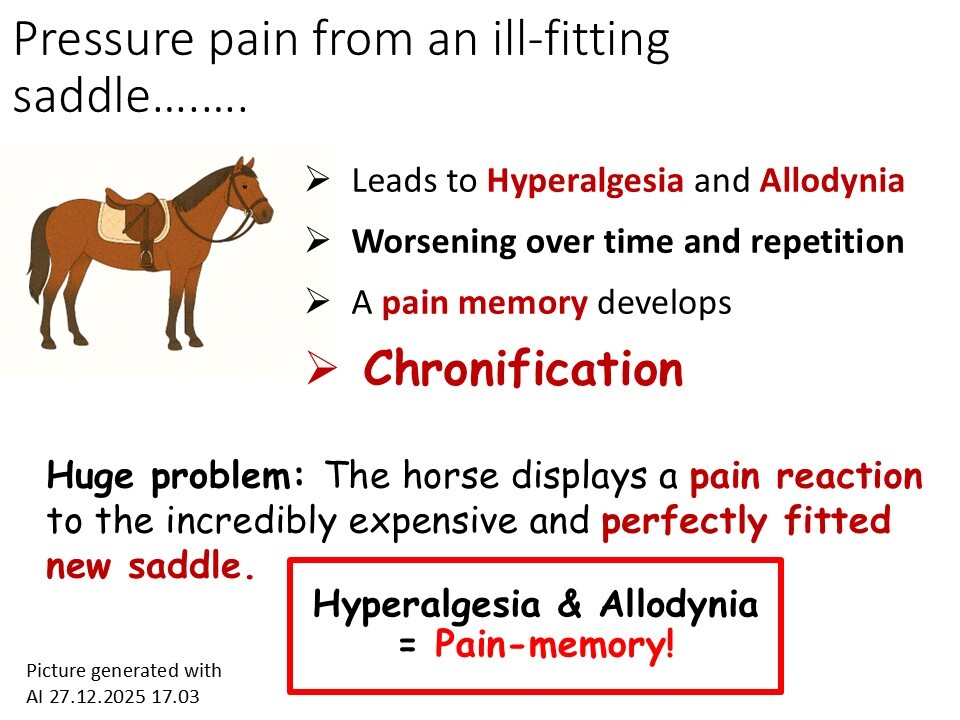
A practical example helps to make this concrete. Imagine a horse worked for many months in an ill-fitting saddle. The constant pressure and tissue irritation provide a steady stream of painful input. Over time the nervous system adapts by becoming more vigilant and responsive. Even after the owner replaces the saddle with a professionally fitted one, the horse may still show avoidance, flinch when being tacked up, or refuse to move forward. The saddle has been fixed, yet the nervous system still experiences pain and remains on high alert—so the response, while puzzling, is nevertheless real.
Figure 5: The potential long-term consequences of an ill-fitting saddle.
The good news is that the nervous system is plastic in both directions! The same
capacity that allowed sensitization to develop can also support recovery. But unlike changing a piece of equipment, recalibrating pain processing takes time and a deliberate approach. The first crucial step is to identify and remove ongoing sources of painful input: in this case a correct saddle fit. If the body keeps sending pain signals, the nervous system has little reason to quiet down.
Beyond removing the cause, recovery typically involves graded, predictable, pain-free experiences that teach the nervous system the situation is safe. Carefully controlled exposure to grooming and tack, slow and progressive exercise tailored to the horse’s condition, and routines that reduce stress in general (remember: not all stress is pain related, but pain induces always a stress reaction) all contribute to the down- regulation of the nervous system. Small wins matter: a few pain-free saddling sessions without riding, maybe even without fixing the girth, calm handling, and consistent positive reinforcement help the horse relearn that those stimuli are not threats. Expect gradual changes rather than instant fixes. Depending on how long sensitization has been present, improvements can take weeks to months, and in some longstanding cases, full resolution may be incomplete. Still, many horses show substantial gains: decreased reactivity, increased comfort under saddle, improved performance and better overall welfare. Patience and consistency are the allies here; pushing a sensitized horse too quickly can reinforce fear and prolong the process. One of the most wonderful examples that I have ever seen or heard about is an amazing “quick fix” of a saddle issue reported by Lynn Acton ( Girthy Horses and Quick Fixes - Lynn Acton ). Quick fixes are very rare in the horse world, yet this is a great example that
combining the creativity of the trainer, a calming and relaxing atmosphere and giving choices can help a horse retraining a chronic saddling issue and the resulting stress reaction. One element of her approach was to change the saddling routine by fixing the girth from the other side! This element of the whole retraining situation reduces the environmental cues/signals indicating that the stressful and most likely painful situation is about to occur. Allowing the horse to move away from the situation and thus giving choices allows the horse to regulate his stress level on his own terms and adds an element of predictability and controllability to the training. Key elements for retraining a
stressful and fear loaded situation!
Understanding pain as a process the nervous system also in part learns, changes how we respond to horses in distress. The good news in this understanding is, that what can be learned can to a large extend be retrained (in fact, not “unlearned”. But that is a topic for another blog on learning theory ). Understanding the neurophysiology of chronic pain does not leave us as trainers helpless, quite the opposite. Knowledge invites curiosity instead of blame, and treatment plans that combine fixing physical problems with retraining the nervous system and the related stress reaction. Be patient, be kind! With knowledge and understanding, careful management and training, many horses can move from a state of hypersensitivity back toward comfort and function. Pain may leave traces in our four-legged friend just as it would and does in us humans. But it is likewise important to know, this type of pain does not have to define our future!
Wikipedia resources:
Wind-up: https://en.wikipedia.org/wiki/Pain_wind-up
Hyperalgesia: https://en.wikipedia.org/wiki/Hyperalgesia
Allodynia: https://en.wikipedia.org/wiki/Allodynia )
References:
- Casey, C. K. Chasing Pain: The Search for a Neurobiological Mechanism; Oxford University Press, 2019.
- Kavaliers, M. Evolutionary and comparative aspects of nociception. Brain Res Bull 1988, 21 (6), 923–931. DOI: 10.1016/0361-9230(88)90030-5 From NLM.
- Linton SJ, Nicholas MK. Understanding the individual's transition from acute to chronic disabling pain: Opportunities for improved care. Curr Opin Psychol. 2025 Apr;62:101989. doi: 10.1016/j.copsyc.2025.101989. Epub 2025 Jan 4. PMID: 39824045.
- Mantyh, P. W. The neurobiology of skeletal pain. Eur J Neurosci 2014, 39 (3), 508–519. DOI: 10.1111/ejn.12462 From NLM.
- Raja, S. N.; Carr, D. B.; Cohen, M.; Finnerup, N. B.; Flor, H.; Gibson, S.; Keefe, F. J.; Mogil, J. S.; Ringkamp, M.; Sluka, K. A.; et al. The revised International Association for the Study of Pain definition of pain: concepts, challenges, and compromises. Pain 2020, 161 (9), 1976–1982. DOI: 10.1097/j.pain.0000000000001939 From NLM.
- Raja SN, Campbell JN, Meyer RA. Evidence for different mechanisms of primary and secondary hyperalgesia following heat injury to the glabrous skin. Brain. 1984 Dec;107 ( Pt 4):1179-88. doi: 10.1093/brain/107.4.1179. PMID: 6509313.
Short, C. E. Fundamentals of pain perception in animals. Applied Animal - Behaviour Science 1998, 59 (1), 125–133. DOI: https://doi.org/10.1016/S0168-1591(98)00127-0.
- Smith, E. S.; Lewin, G. R. Nociceptors: a phylogenetic view. J Comp Physiol A Neuroethol Sens Neuraln Behav Physiol 2009, 195 (12), 1089–1106. DOI: 10.1007/s00359-009-0482-z From NLM.
- Sneddon, L. U. Comparative Physiology of Nociception and Pain. Physiology (Bethesda) 2018, 33 (1), 63–
73. DOI: 10.1152/physiol.00022.2017 From NLM.