
Myth or Fact? Exploring the Claim That Horses Feel Less Pain Than Humans

Following the remarkable response to our publication, “What if Horses Were Humans? Comparing Rein Tension and Bit Pressures to Human Pressure Pain Thresholds,” (Musial & Weiss, 2025) which garnered an impressive number of views in a short period, it seems timely to revisit a widely held belief: the notion that horses are less sensitive to pain than humans.
Even though it is hard to believe, I have experienced that claim myself only a couple of years ago, a riding instructor urging me to beat the school horse I was riding upon. “Just go ahead, use your whip, she is just lazy, and their skin is a lot thicker than ours anyway. It won’t hurt, just motivate her”. Others have heard this too. Is there any truth in it? By no means!!!
Since you’re reading this, I assume you may have had a similar experience—and, like me, you didn’t believe it. Perhaps you even felt the opposite, that horses are extremely sensitive creatures. However, pain in horses is, in fact, incredibly difficult to assess. Unlike humans, who tend to express pain openly, horses—being prey and flight animals—are evolutionarily primed to hide their pain as a survival mechanism. A fact, that makes it significantly harder for us, as their caretakers, to recognize their silent suffering.
Adding to this challenge but very much in line with their evolutionary make up is the fact that horses, unlike other animals that share close relationships with humans, such as dogs and cats, lack specific vocalizations to express pain – they cannot cry out loud, when they are hurting! Dogs and cats, as fellow predators, are more similar to humans in their behavior and communication, which makes it easier for us to recognize when they are in pain and distress. If horses expressed pain as openly as humans or dogs, some riding arenas might still echo with the painful cries of mistreated horses. Tragically, however, horses suffer in silence, making it our responsibility to learn how to identify and address their discomfort with care and compassion. Furthermore, it hardly needs to be emphasized that the use of pain as a training method should be unacceptable.
Pain itself is a complex and multifaceted experience. The International Association for the Study of Pain (IASP) defines it as "an unpleasant sensory or emotional experience that is associated with or resembles actual or potential tissue damage" (Raja et al., 2020). This definition highlights not only the physical but also the emotional dimensions of pain. In humans, pain is often intertwined with intense emotions such as fear, anxiety, and even depression. This connection is so profound that emotional suffering, such as the loss of a loved one, is often described in terms of physical pain—phrases like "it hurts so much" or "it breaks my heart" are common expressions of this overlap.
While horses and humans are different in many ways, they are both mammals and share fundamental physiological processes, including those involved in pain perception. The physiological process of pain detection, known as nociception, is expected to be relatively consistent across mammals (Mantyth, 2014; Short 1998; Kavaliers, 1988; Sneddon, 2018; Smith & Lewin, 2009). However, the subjective experience of pain and the thresholds for detecting and tolerating it can vary between species. Pain detection threshold refers to the minimum stimulus intensity at which pain is first perceived, while pain tolerance refers to the maximum level of pain an individual can endure before it becomes unbearable. These thresholds are influenced by a species' lifestyle, habitat, and evolutionary adaptations.
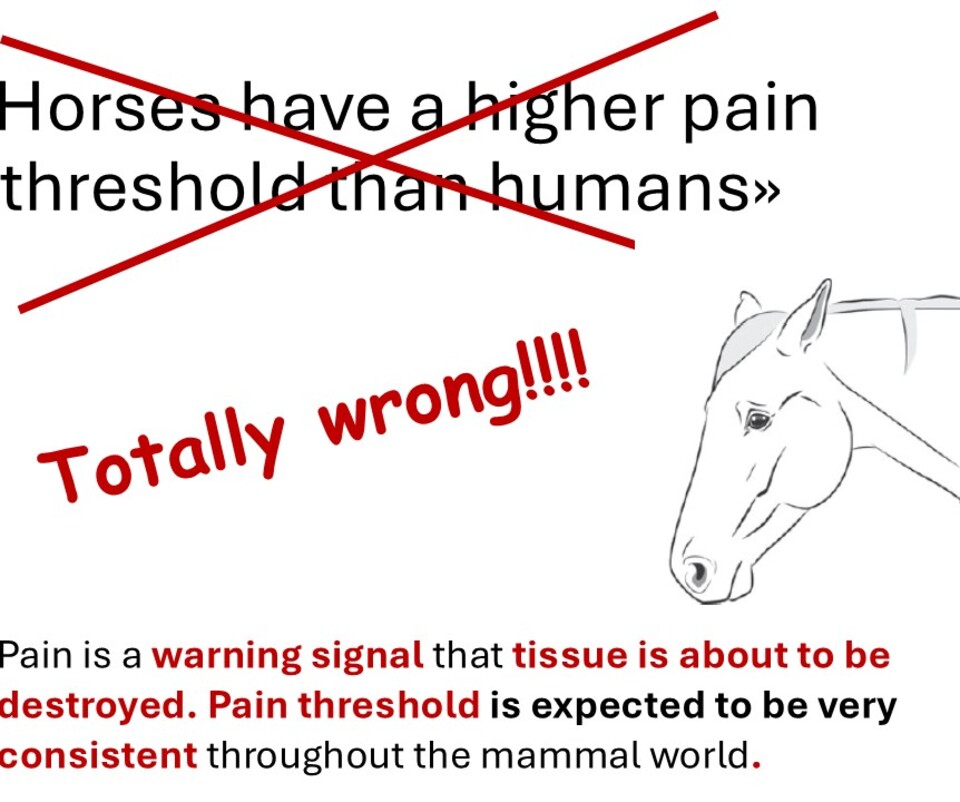
As prey animals, horses are believed to have developed a high pain tolerance, enabling them to endure and manage intense pain. This does not mean that horses feel less pain than humans or other animals; rather, they have evolved strategies to suppress visible signs of discomfort in the presence of potential predators. Predators typically target prey that can be captured with minimal effort, as this helps them conserve energy and reduces their own risk of injury. Horses in pain may even reduce their expressions of discomfort during caretaker visits (Torcivia & McDonnell, 2020). This behavior, while adaptive in the wild, poses significant challenges for those responsible for their welfare, as it makes recognizing and addressing pain more difficult.
Interestingly, research has confirmed that the basic anatomical structures for detecting pain in horses and humans are similar. A recent study comparing the gluteal skin of horses and humans found that the superficial pain-sensitive epidermal layer in horses is as richly innervated and of equivalent thickness to that of humans (Tong et al. 2020). This supports the idea that the mechanisms of pain processing in horses and humans are fundamentally alike. However, the way pain is experienced and regulated differs, largely due to the horse's nature as a flight animal.
As already discussed, horses tend to suppress signs of pain and lack vocalizations associated with it. This distinguishes them from other domestic species, such as dogs, who are in this regard more similar to humans. The unique nature of the horses' pain-related behaviors has been recognized as a significant welfare issue, prompting considerable efforts to improve the diagnosis of pain and associated behaviors in horses (e.g. Torcivia & McDonnel, 2021; Dalla Costa et al. 2018; Gleerup et al., 2015).
In conclusion, understanding pain in horses calls for a thoughtful and empathetic approach that includes both their physiological similarities to humans and their unique instincts as prey animals. While horses may not always express pain in ways that are obvious to us, it is important to remember that their suffering is no less significant. It may even be worse than we are able to anticipate or perceive, because horses suffer in silence. As their caretakers and advocates, we have a profound responsibility to educate ourselves about the subtle signs of their discomfort and to respond with kindness, care, and compassion. In our care, these gentle creatures rely on us to safeguard their well-being. It is our duty to ensure they live free from unnecessary pain. They deserve nothing less.
See also my blog “Pain – Let’s talk about it”
References:
- Casey, C. K. Chasing Pain: The Search for a Neurobiological Mechanism; Oxford University Press, 2019.
- Dalla Costa, E.; Minero, M.; Lebelt, D.; Stucke, D.; Canali, E.; Leach, M. C. Development of the Horse Grimace Scale (HGS) as a pain assessment tool in horses undergoing routine castration. PLoS One 2014, 9 (3), e92281. DOI: 10.1371/journal.pone.0092281 From NLM.
- Gleerup, K. B.; Forkman, B.; Lindegaard, C.; Andersen, P. H. An equine pain face. Vet Anaesth Analg 2015, 42 (1), 103–114. DOI: 10.1111/vaa.12212 From NLM.
- Kavaliers, M. Evolutionary and comparative aspects of nociception. Brain Res Bull 1988, 21 (6), 923–931. DOI: 10.1016/0361-9230(88)90030-5 From NLM.
- Mantyh, P. W. The neurobiology of skeletal pain. Eur J Neurosci 2014, 39 (3), 508–519. DOI: 10.1111/ejn.12462 From NLM.
- Musial F, Weiss T. What if Horses Were Humans? Comparing Rein Tension and Bit Pressures to Human Pressure Pain Thresholds. Animals (Basel). 2025 Oct 15;15(20):2989. doi: 10.3390/ani15202989. PMID: 41153916; PMCID: PMC12560900.
- Raja, S. N.; Carr, D. B.; Cohen, M.; Finnerup, N. B.; Flor, H.; Gibson, S.; Keefe, F. J.; Mogil, J. S.; Ringkamp, M.; Sluka, K. A.; et al. The revised International Association for the Study of Pain definition of pain: concepts, challenges, and compromises. Pain 2020, 161 (9), 1976–1982. DOI: 10.1097/j.pain.0000000000001939 From NLM.
- Sherrington, C. The integrative action of the nervous system.; Oxford University Press, 1906.
- Short, C. E. Fundamentals of pain perception in animals. Applied Animal Behaviour Science 1998, 59 (1), 125–133. DOI: https://doi.org/10.1016/S0168-1591(98)00127-0.
- Smith, E. S.; Lewin, G. R. Nociceptors: a phylogenetic view. J Comp Physiol A Neuroethol Sens Neural Behav Physiol 2009, 195 (12), 1089–1106. DOI: 10.1007/s00359-009-0482-z From NLM.
- Sneddon, L. U. Comparative Physiology of Nociception and Pain. Physiology (Bethesda) 2018, 33 (1), 63–73. DOI: 10.1152/physiol.00022.2017 From NLM.
- Tong, L.; Stewart, M.; Johnson, I.; Appleyard, R.; Wilson, B.; James, O.; Johnson, C.; McGreevy, P. A Comparative Neuro-Histological Assessment of Gluteal Skin Thickness and Cutaneous Nociceptor Distribution in Horses and Humans. Animals (Basel) 2020, 10 (11). DOI: 10.3390/ani10112094 From NLM.
- Torcivia, C.; McDonnell, S. Equine Discomfort Ethogram. Animals (Basel) 2021, 11 (2). DOI: 10.3390/ani11020580 From NLM.
- Torcivia, C.; McDonnell, S. In-Person Caretaker Visits Disrupt Ongoing Discomfort Behavior in Hospitalized Equine Orthopedic Surgical Patients. Animals (Basel) 2020, 10 (2). DOI: 10.3390/ani10020210 From NLM.