
What if Horses Were Humans? Comparing Rein Tension and Bit Pressures to Human Pressure Pain Thresholds

Dear friends,
It’s been a bit quiet from me lately. The reason is that I’ve been quite busy with some interesting and important projects in my work as a pain researcher. That said, I haven’t forgotten about Science for Horse Lovers! In fact, I’m happy to share that a project I’ve been working on for a while has just been completed.
Some of you may remember that I had the pleasure of spending a couple of weeks in May and June with my dear friend Jennie Boerema in the stunning landscapes of New Zealand. During my stay, Jennie and I took a trip to Australia (just around the corner 😉) to meet the incredible Equitation Science International (ESI) group led by Dr. Andrew McLean in Tuerong, Victoria. I feel so fortunate to have had Jennie as my travel companion—without her, this trip wouldn’t have been possible.
What a wonderful time we had at ESI’s! The warm welcome, the dedication of the horse enthusiasts, and the fascinating discussions made it truly unforgettable. I learned so much, reflected deeply, and engaged in thought-provoking conversations. Time just flew by!
Andrew and I had the most fascinating and stimulating conversation. He, as a biologist with extensive experience and scientific work in behavioral science, and me, as a psychologist with a background in biopsychology and neuroscience, found ourselves diving deep into some truly thought-provoking topics. Naturally, one of the most debated issues in equitation science came up—the current often emotional discussions surrounding bit-induced mouth pain in horses.
Then came the question from Andrew, directed at me, a human pain researcher and passionate horsewoman: “Do you believe it is possible to ride with a bit and not induce pain?”
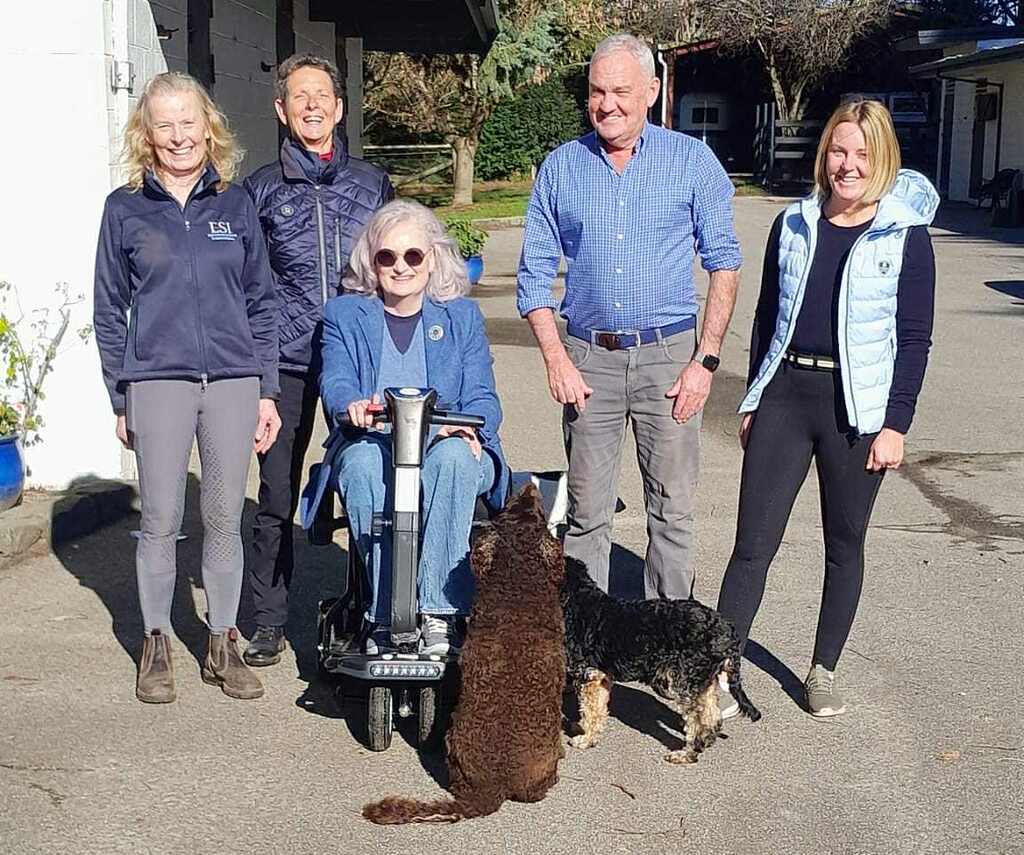
Jennie and I visiting Equitation Science International (ESI) in Tuerong, Victoria, Australia. A most inspiring meeting with consequences. Heartfelt thanks go out to Sophie, Helen, Manuela (not in the picture) und Andrew.
I have to admit, I couldn’t answer that question right away. But his question stayed with me—it kept “haunting” my thoughts long after our conversation. I began to wonder how such an important question could ever be answered. After all, we can’t simply ask horses how they feel, so how can we approach this complex and crucial issue?
I am not conducting research on horses myself; when it comes to horses, I see my role more as a research communicator. That said, I do have extensive knowledge about pain. Pain is an evolutionarily fundamental yet highly complex phenomenon that serves as a warning signal, indicating a threat to the body’s integrity. It encompasses both the neurophysiological processes involved, known as “nociception,” and an unpleasant emotional component that triggers behavioral responses to help us avoid harm.
While nociception is thought to be relatively similar across mammals (and, according to some, even across vertebrates), the experience of pain as a subjective phenomenon may vary between species, shaped by their unique ways of living and survival strategies.
Animals have been extensively used as model species to study human pain processing. If other species are considered similar enough to humans to serve as models for pain physiology, then it stands to reason that humans could, in turn, be used as model species for understanding pain in another mammal, horses. Given my expertise in the field of human pain, I believed this perspective could offer valuable insights.
I reached out to my dear friend and long-time scientific collaborator, Thomas Weiss—one of the most brilliant pain experts I know—to see if he would join me in this endeavour. The result of our collaboration is a scientific paper, published in a well-respected, peer reviewed scientific journal, “Animals” where we compare the extensively studied human pressure pain thresholds to the rein tensions reported in the scientific literature (Musial, F., & Weiss, T. (2025). What if Horses Were Humans? Comparing Rein Tension and Bit Pressures to Human Pressure Pain Thresholds. Animals, 15(20), 2989. https://doi.org/10.3390/ani15202989) .
If we accept the human animal as a model species for horses, our findings suggest that most rein tensions—and the resulting pressures on the structures within a horse’s mouth—would likely cause strong to severe, and even intolerable, pain sensations in humans. Only the lowest pressures, such as minimal rein contact or riding with loose reins, would fall below the human pressure pain threshold.
Can I answer Andrew’s question now? Yes, if the human primate is accepted as a model species for horses, our data suggest that it is possible to use a bit without inducing pain and to keep rein tension below the pressure pain threshold. However only, if a horse is ridden with loose reins or minimal contact / rein tension. It’s important to note that this also applies to some extent to bitless bridles, as they too function through pressure and release.
I must admit, when we began closely examining the available data on rein tension, I was shocked by the extreme pressures reported in the scientific literature. If we accept that this is what we, as riders, have been doing for thousands of years—and still do—then raising awareness about the implications for our four-legged companions becomes a crucial first step toward preventing pain. In this regard, our paper is, of course, just one of many published in recent decades. Beyond the findings of our own paper, the key takeaway from the growing body of scientific literature on this topic is clear: reins—and the equipment they are attached to—have the potential to cause severe pain if not used with care and understanding.
Beyond all these concerns, it is of utter importance for me to acknowledge that the vast majority of equestrians would never intentionally inflict pain on their horses, to whom they are often deeply bonded. However, it’s crucial to recognize that training horses in most equestrian disciplines fundamentally relies on the pressure–release principle, which inherently involves the use of potentially harmful stimuli. This makes it clear that ethical horse training depends more than ever on the skill and sensitivity of the rider, as well as the proper education and training of the horse.
Let us strive to be kind—not only to our horses but also to one another. Shaming and blaming have never led to meaningful progress. Instead, let’s use the growing body of scientific literature on rein tension and mouth pain in horses as an opportunity to educate ourselves. By doing so, we can work towards becoming better, more compassionate equestrians—for our own growth and, most importantly, for the well-being of our beloved four-legged companions.
With warm regards
Frauke
Science for Horse Lovers
Please find the link to the publication here: