
Of horses and humans, and the freedom to choose - Part 3: Protected contact – the ultimate choice
Dear Reader,
Welcome to Part 3 of our mini-series on choices in horse handling, training, and husbandry. In this final installment on the topic of choices, I will explore the method of "protected contact" in horse handling. Additionally, I will introduce an innovative perspective on this well-known paradigm.
Protected contact is commonly employed in zoos when handling potentially dangerous animals. For instance, during medical training, animals such as gorillas or tigers voluntarily approach a barrier to receive treatment. Typical procedures include vaccinations or inspections of teeth, feet, paws, or hooves. This training is usually conducted using positive reinforcement, often applying clicker training.
This approach offers significant advantages for everyone involved: health monitoring and treatment become much easier, it reduces stress for both the handler and the animal, and it minimizes the need for anesthesia. In this sense, protected contact creates a win-win situation for all parties. For an example of advanced medical training with a tiger, you can watch this video: https://www.facebook.com/watch/?v=268291613776682
Similar to its use in zoos with dangerous animals, protected contact in horse training is employed to safeguard the trainer from potentially hazardous horses. This method enables the trainer to work with the horse without compromising their own health and safety. By eliminating the element of danger from the training environment, it fosters a calmer and more relaxed atmosphere. Importantly, the trainer can focus on the task at hand without the constant concern for personal safety.
A few years ago, I was somewhat surprised to discover myself that there is more to the paradigm of protected contact than one might initially assume. Reflecting on this now, I would confidently assert that protected contact is an underestimated approach that could be more widely applied in horse training than commonly thought, even in non-dangerous situations where safety concerns are not an issue. One crucial aspect of this method is its dual protective nature: while it safeguards the human, it also protects the horse from the human.
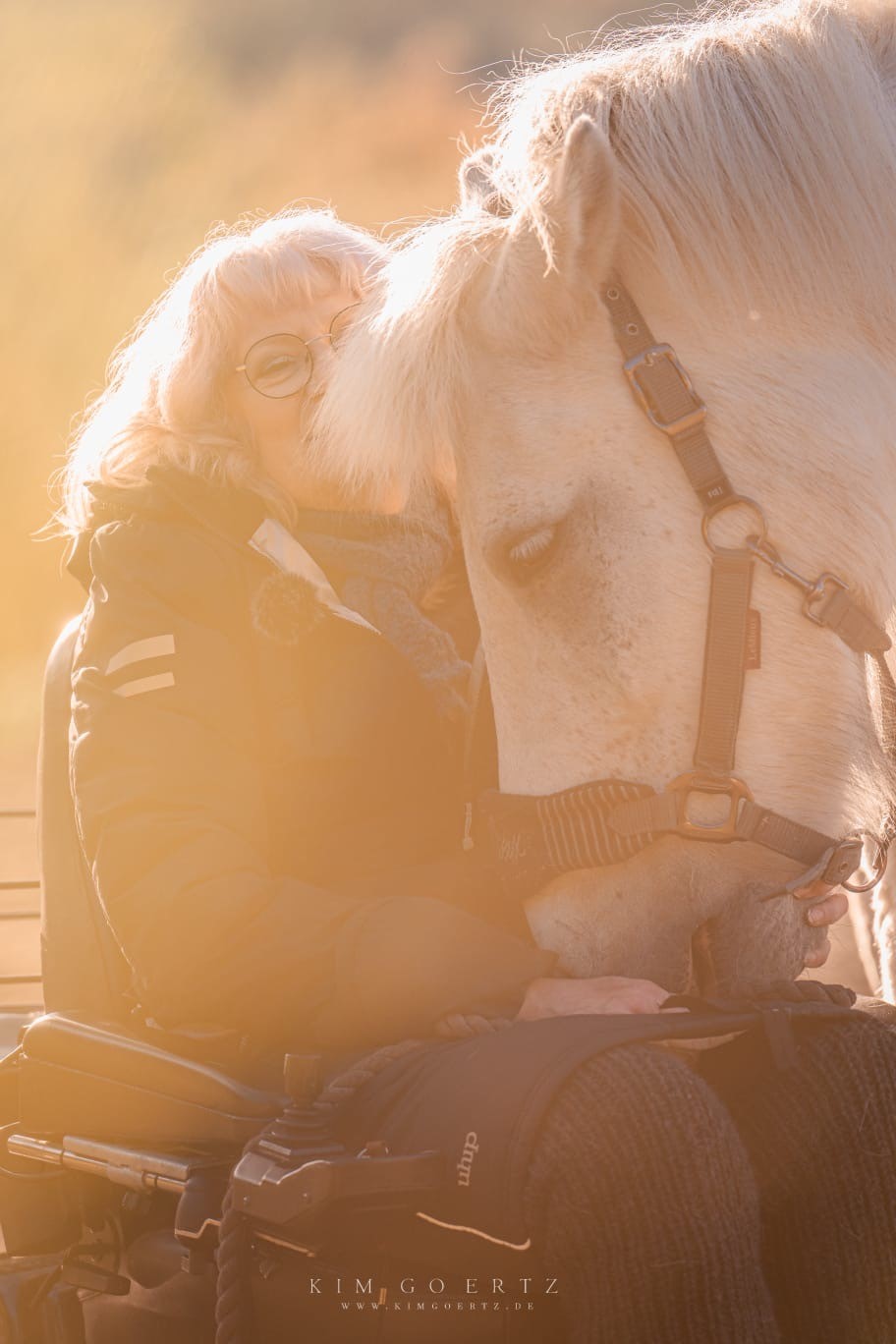
Many of you may be aware that I have a significant walking disability due to multiple sclerosis. Additionally, my hands are somewhat impaired, and while I can walk with the aid of two crutches, maintaining balance is challenging. Tasks such as fastening a halter or bridle with my affected hands can be particularly difficult. Therefore, what I truly need is a horse that stands still and is tolerant of my clumsiness when handling or adjusting tack.
My dear Frar is as patient as a horse can be, typically standing still like a statue when I attempt to put a halter on him. However, a few years ago, he was kicked in the face while playing, resulting in swelling around his eye and the entire right side of his face for several days. Fortunately, he recovered without any lasting injuries, but he became quite head shy afterward, refusing to let me touch his ear, let alone put on a halter or bridle.
This posed a serious problem for me, as I am the last person to resort to any form of force or chase after him. 😉 Needless to say, there was not the slightest chance of success with such an approach.
Video 1: The Problem. Frar has developed head shyness after being kicked in the face. Although there was no lasting injury and his face and ear should be fine and pain-free, he remains sensitive. As a result, I am unable to touch his ear, preventing him from learning that everything is okay again.
This video illustrates the situation: I have no chance of touching Frar's ear. He skillfully withdraws just far enough to prevent me from reaching it. I assure you, I haven't managed to touch it even once. Without being able to touch his ear, Frar cannot experience that my touch is no longer uncomfortable or painful.
Moreover, from a learning theory perspective, each time he successfully avoids my touch, he receives negative reinforcement for withdrawing. My attempt to touch his ear acts as a negative stimulus, which he perceives as unpleasant. When he withdraws, this tension or negative stimulus is reduced or disappears, perfectly reinforcing his withdrawal response. This is how phobias are developed 😉
If you'd like to refresh your knowledge on learning theory, feel free to check out my blog: [Learning by Success: From Thorndike's Puzzle Box to Houdini Horses] (https://www.scienceforhorselovers.com/en/blog-entry/learning-by-success-from-thorndike-s-puzzle-box-to-houdini-horses-a-short-gallop-through-learning-theory ).
My “simple” straightforward plan was to gently scratch Frar's face and neck, then slowly and carefully approach his ear, allowing him to learn that his ear was perfectly fine again. This approach is akin to "systematic desensitization," aimed at habituating him to having his ear touched. Given that he usually enjoys being scratched—especially behind his ears—I was quite confident that this strategy would be effective. Video 2 shows what happened (aside from him chewing on some hay from the ground)...
Video 2: An attempt to desensitize Frar to me touching his ear. Despite my efforts, he successfully avoids contact, clearly indicating his reluctance to engage with me when I persist in bothering him.
This session was a complete success—for Frar! 😉 He effectively avoided being touched around his ear and withdrew from me. The only way to proceed from there would have been to try to restrain him and touch his ear, which would involve using some degree of force. Not only is this approach impossible for me, but it also goes against my training philosophy.
Nonetheless, I needed to address this ear issue, as it worsened with each attempt to resolve it—demonstrating the power of negative reinforcement. This situation highlighted once again that handlers are often the cause of many unwanted behaviors in horses, as we inadvertently reinforce these behaviors without realizing it.
Returning to Frar's ear problem, I was uncertain about how to proceed without exacerbating the situation. I was also concerned that my flawed attempts to address the "ear issue" might start to undermine our relationship. From the moment we met, Frar and I shared a strong bond, and over the years, we have developed a very trusting relationship.
As I pondered countless options, I suddenly had the idea of offering him protection from ME. Since the situation couldn't get worse—I couldn't reach him—I decided to wait for him to come to me. So, I positioned myself outside his stall and waited. And that's when it happened...
Video 3: I "promised" Frar that I would remain outside his stall and wait for him to initiate contact. After some time, he approached me, and in the end allowed me to scratch his ears and put the halter on.
The video is quite lengthy because it took some time for Frar to approach. However, for the experienced observer, there are many interesting behaviors to notice. I also chose not to use treats, as I prefer to avoid food rewards in "regular" everyday handling situations. Additionally, Frar typically enjoys being scratched, making it both easy and pleasurable to reward him in this way, as his affectionate reactions are truly priceless.
Initially, I attempted my original approach of systematic desensitization, but this time from outside his stall. I tried scratching his neck and face, gradually working my way up to his ears. Frar stood still while I scratched his neck, but as soon as I approached the base of his ear, he withdrew. I decided to remain quietly outside the stall without making any further attempts to engage him.
After a while, he returned to me, and I repeated the process, trying to scratch him near his ear on his face and neck, while deliberately avoiding the ear. However, this was not what he wanted, so he withdrew again. And I waited...
After some time spent searching for hay on the ground, Frar returned to me and touched my hand with his muzzle. However, he then withdrew to the left front corner of his stall, where his friend was located (not visible in the video). This position was out of my reach, but he maintained full oversight of my actions, keeping his left eye focused on me.
I moved a bit closer, attempting to make contact. I scratched his neck, but he remained in his position. When I made a brief hand movement toward his ear, his tension immediately increased, prompting me to withdraw my hand right away. I made a short attempt to scratch his face, but my intuition told me he wasn't enjoying it, so I returned to my original position, further away, and waited while he watched me intently.
I noticed a blink, and he seemed to relax a bit, but a brief attempt to scratch his neck caused him to stiffen again. Therefore, I continued to stand quietly, waiting for a reaction from him.
Then, all of a sudden, something amazing happens: Frar reaches over the wall, grabs the rope halter that was hanging there, and throws it on the ground. Since he often uses throwing objects to communicate intentionally with me—such as tossing the feed bucket when it's empty—I interpret this as a signal that he's ready for another attempt.
Instead of picking up the halter, I continue with the same approach: scratching his neck and face, then carefully proceeding to his ear. My immediate goal is to show him that it's okay to be touched on the ear, helping him learn that it's no longer painful and allowing him to habituate to the touch. Putting the halter on is secondary to resolving his head shyness.
Remarkably, I am allowed to touch and scratch his ears. After a while, he becomes tense again and withdraws, but not very far. I respect his reaction, let go and pick up the rope halter.
As I approach with the halter, which Frar has undoubtedly seen hanging from my arm, he reaches over the fence and turns his head halfway toward me—our usual position for putting the halter on. Instead of immediately placing the halter, I take another round of scratching, including his ears.
Amazingly, I find that he finally seems to enjoy the scratches, even when I "explicitly" include his ears. He lowers his head and his eyes soften; it appears as though his entire body relaxes.
In the next step, Frar allows me to halter him, even though he withdraws slightly. Remarkably, he stays with me, despite being able to easily move away completely. It's worth noting that this is one of the most challenging situations for me to put a halter on: I struggle to stand without crutches (as both hands are needed for haltering), reaching forward throws me off balance, and my partially lame hands make haltering quite an exercise. Consequently, I am even more clumsy than usual, but this wonderful horse and companion just hangs in there. ❤️
When my movements with the halter become too erratic, he steps back slightly, but he makes no serious effort to leave. I ensure to make room for scratches whenever possible, now that he enjoys them again. After quite a long while, during which he stands still like a hero, I finally manage to secure the knot.
I adjust the halter slightly, but the main task is accomplished. Jarpi, Frar's comrade, reaches out to him, seemingly “commenting” on the great success. I continue scratching Frar, though he doesn't appear completely relaxed. For a few seconds, it seems he's evaluating the situation with the halter on; he stands very still but remains quite alert.
Then, suddenly, he licks my hand and comes close to me. It's at my side that he finally relaxes. His licking my hand indicates how much tension there was to release.
Resolving head shyness in just two sessions is quite rapid, and I believe this was an unusual situation. First and foremost, Frar and I share a very trusting and close relationship, so I didn't need to earn his trust from scratch. He generally trusted me, just not with his ears at that time. The situation would likely have been far more challenging without the strong bond we already had.
Nonetheless, what I would identify as the most important effect of offering choices in horse training (see Part 2)—is that this "freedom to choose" provides the horse with the opportunity to manage his fears on his own terms and timeline. It was very apparent in Frar's training that allowing him to take breaks whenever he wanted was enormously beneficial for treating his ear and touch related anxiety.
Although many paradigms based on the choice approach utilize negative (removal) reinforcement, which is certainly effective, I prefer to incorporate positive reinforcement into training situations whenever possible. Negative reinforcement is a useful tool for initiating and confirming a response; however, when this "correct" response is subsequently positively reinforced (rewarded) with a scratch or treat, it can significantly enhance the overall training atmosphere. This “combined reinforcement” is the most effective approach in all learning environments.
As I mentioned in Part 2, I largely favor scratches as reward because they tap into the intrinsic attachment system that horses and humans share—a system whose existence is an invaluable asset in horse training. Nonetheless, I am not opposed to food reinforcement (treats) when timed appropriately, especially when scratches are not an option. One example of such a situation is hoof care in a Takhi horse. 😉
Takhis, also known as Przewalski's horse, the Mongolian wild horse, or Dzungarian horse, are rare and endangered horses originally native to the steppes of Central Asia. They are named after the Russian geographer and explorer Nikolay Przhevalsky. A well-organized breeding program aims to ensure the survival of this last truly wild horse, which is genetically distinct from modern horses, including feral ones. This program is conducted in cooperation with a large network of zoos and other organizations concerned with the preservation of wildlife.
To date, some smaller groups of Takhis have been successfully reintroduced into their natural habitat. If you're interested in learning more about this remarkable horse and the story of humans and horses, feel free to read my blog: Of Horses and Humans and How It All Began: The Ancient Botai Culture of Kazakhstan (https://www.scienceforhorselovers.com/en/blog-entry/of-horses-and-humans-and-how-it-all-began-the-ancient-botai-culture-of-kazakhstan ).
Takhis, much like zebras, are nearly impossible to tame and are typically kept in protected contact or semi-wild environments. Similar to many horses and zebras, Takhis can also develop hoof problems, which are challenging to treat due to the need for sedation during treatment. However, innovative alternatives have since been developed.
This video showcases the remarkable success achieved by a creative and knowledgeable team of hoof care specialists using a paradigm that combines protected contact with food reinforcement: Voluntary Hoof Care at Denver Zoo https://www.facebook.com/watch/?v=1826939138092457&rdid=ZvmCnqpPFCeLRplY .
Isn't it amazing what can be achieved by giving an animal choices, allowing them the opportunity to regulate their fears independently, and consistently rewarding them when they successfully manage these challenges? In my view, there is much more to the freedom to choose, as I've likely mentioned before. 😉
Making choices and having the opportunity to actively cope with fears makes our four-legged friends less prone to anxiety and mentally stronger. The experience of successfully handling a fearful situation teaches one of the most important lessons we can all learn: "I have done this before; I can do it again." And then, suddenly, things can change almost instantly, as it did with Frar's touchy ear.
Of course, Frar and I share a strong bond that connects us. While scientists often refer to this as "attachment" when discussing animals, a horse lover can also allow herself to call it what it truly is: "love." This bond of love surely makes a significant difference.
However, the freedom to choose can still be a game changer, even when there is no special bond in place. Positive reinforcement in the form of food, combined with the ultimate form of choice—protected contact—can lead to remarkable results (remember the tiger). And there's more to it. Consider the video with the Takhi, Bataar, getting his hooves done. Didn't I mention that Takhis, like zebras, are extremely difficult to tame and quite aggressive?
Bataar clearly has developed a bond with his caregiver, even when he's not getting his hooves done and earns treats. These two have progressed to being touched, to scratches, which Bataar obviously appreciates and even enjoys. How far this bond would carry in another setting remains unknown. Nonetheless, observing these two, I would say that the training has made all the difference in the world for them. ❤️
Further information on the Przewalski's horse and medical training: https://www.youtube.com/watch?v=LKnD_4KQp0I